Stutsman County Dog Registration Information
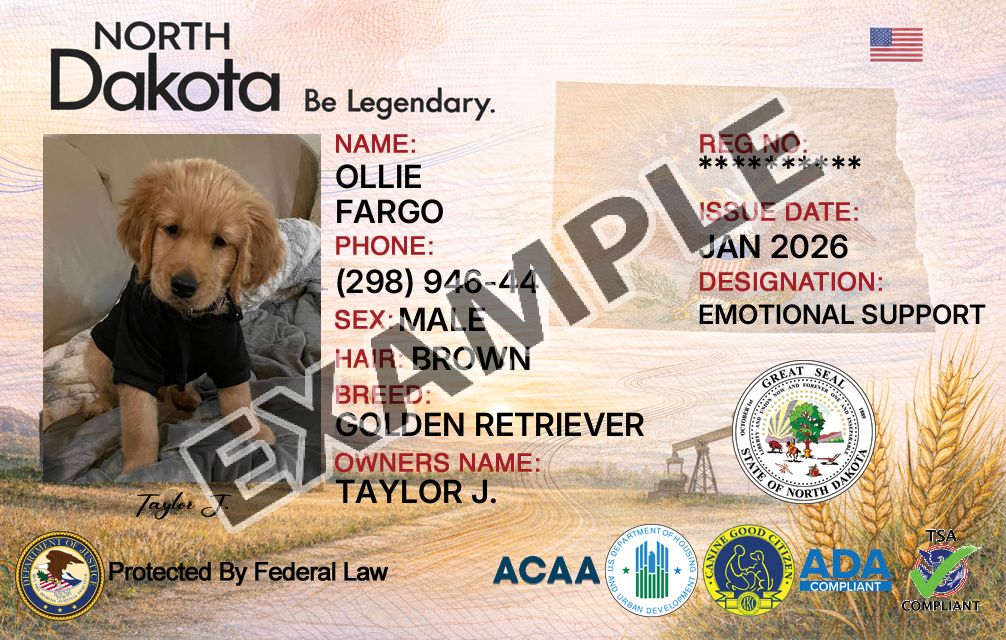
Service Dogs and Emotional Support Animals in Stutsman, North Dakota
If you’re asking, “where do I register my dog in Stutsman County, North Dakota for my service dog or emotional support dog?” the key thing to know is that dog licensing is usually handled locally (most often by your city)—while “service dog” and “emotional support animal (ESA)” status comes from different laws and does not come from a county registration database.
This page explains how to get a dog license in Stutsman County, North Dakota, what to do if you live inside or outside city limits, what rabies proof is typically required, and how an animal control dog license Stutsman County, North Dakota question is different from proving a dog is a service animal or an ESA.
- A dog license is a local registration tag/record (usually city-issued) tied to rabies vaccination and ownership.
- A service dog is defined by disability-rights laws and training to perform tasks—there is typically no official “service dog registration” required for public access.
- An emotional support animal is generally relevant to housing accommodations and does not grant the same public-access rights as a service dog.
Where to Register or License Your Dog in Stutsman County, North Dakota
Because licensing is often handled at the city level, the most common place to register a dog in Stutsman County is the city office or law enforcement records office where animal ordinances are enforced. Below are example official offices within Stutsman County, North Dakota that residents commonly contact for licensing, animal control, rabies enforcement questions, or help determining which local rules apply.
Official offices (examples within Stutsman County)
| Office | Address | Phone | Hours | |
|---|---|---|---|---|
|
Jamestown Police Department Records Office (Dog/Cat Licensing & Animal Control) |
205 6th Street SE, Suite 101 Jamestown, ND 58401 |
701-252-2414 | Not listed | Mon–Fri, 8:00 AM–5:00 PM |
|
Stutsman County Sheriff’s Office County law enforcement (incidents/complaints outside city limits) |
205 6th St SE, Suite 102 Jamestown, ND 58401 |
701-252-9000 (Report an Incident) 701-251-6200 (General Inquiries) |
sheriff@stutsmancounty.gov | Mon–Fri, 8:00 AM–5:00 PM (county hours) |
|
Central Valley Health District Public health (rabies guidance, bite/exposure questions) |
122 2nd Street NW Jamestown, ND 58401 |
701-252-8130 | Not listed | Not listed |
Note: Jamestown’s official animal control guidance states that licenses are obtained through the Jamestown Police Department Records Office at the Law Enforcement Center. County sheriff contact details are published by Stutsman County. Central Valley Health District contact information is published by the health district. (No external links shown.)
Overview of Dog Licensing in Stutsman County, North Dakota
What “registering your dog” usually means
In most of Stutsman County, “registering” your dog means getting a local dog license (sometimes called a pet license) through the city where you live. The license typically results in a tag number tied to your name, address, and vaccination record. If you live in a city like Jamestown, the city’s animal ordinances and enforcement processes apply. If you live outside a city’s limits, county-level law enforcement may be the primary contact for roaming dogs or complaints, while licensing requirements can vary by local jurisdiction.
Why licensing is handled locally
Dog licensing is commonly managed by local government because animal ordinances (running at large, nuisance barking, leash rules, impound procedures, and local licensing fees) are often adopted and enforced at the city level. That’s why “where to register a dog in Stutsman County, North Dakota” usually starts with identifying your city of residence (if any), then contacting that city’s designated licensing office.
Rabies vaccination requirements (why proof is requested)
Local licensing programs frequently require proof of current rabies vaccination before they can issue a license. In Jamestown, the city’s animal control guidance indicates dogs and cats within city limits must be licensed and must have proof of current vaccinations, and that rabies vaccination certificates are required at the time of licensing. If you have questions about rabies exposures, bites, quarantine rules, or public health recommendations, a local public health unit (such as Central Valley Health District) is often the appropriate place to ask what to do next.
How Dog Licensing Works Locally in Stutsman County, North Dakota
Step 1: Identify your jurisdiction (city limits vs. rural Stutsman County)
Start by confirming whether your address is within a city’s boundaries (for example, within Jamestown city limits) or in an unincorporated area of Stutsman County. This matters because the office that issues a dog license in Stutsman County, North Dakota is often a city office, not a county office.
Step 2: Contact the local licensing office for the process and fee schedule
In Jamestown, the city’s official animal control page states that a license may be obtained at the Jamestown Police Department Record’s Office in the Law Enforcement Center. The city also publishes licensing fee examples and indicates licensing applies to dogs and cats within city limits over a specified age threshold, with proof of rabies vaccination (and spay/neuter documentation when applicable) required at the time of licensing.
Step 3: Prepare your documents (rabies proof is commonly required)
Licensing offices commonly ask you to bring or present proof of current rabies vaccination (such as a rabies certificate from your veterinarian). Some locations also request proof of spay/neuter for discounted licensing tiers, and many will ask for basic owner identification and a current address. If you’re licensing a new pet, renewing a license, or updating an address, ask the office what documentation they accept and whether they issue a tag same-day.
Step 4: Know who handles enforcement or complaints
If you’re calling about a roaming dog, a bite, aggressive animal behavior, or nuisance issues, the “right” contact may differ based on location: within a city, animal control functions may be handled through the police department; outside city limits, the county sheriff’s office is often the primary law enforcement contact. When in doubt, provide your address first and ask which agency has jurisdiction.
Even if your dog is a trained service dog or an emotional support animal, your city may still require a local license tag for dogs residing in the city. Licensing is about ownership identification and vaccination compliance, not about disability status.
Service Dog Laws in Stutsman County, North Dakota
What legally makes a dog a service dog
Under the Americans with Disabilities Act (ADA), a service animal is generally a dog that is individually trained to do work or perform tasks for a person with a disability. The tasks must be directly related to the person’s disability. If the dog’s presence provides comfort but the dog is not trained to perform a specific task, it is not a service animal under the ADA.
Do you have to register a service dog with the county?
For public access under the ADA, there typically is no government-issued “service dog registration” required. In other words, you generally do not “register” a service dog with Stutsman County to make it a service dog. However, a city may still require a standard pet license for dogs living in that city. Think of these as two separate tracks: local licensing (rabies/ownership) and service-dog status (training and disability-related tasks).
What businesses or staff may ask (and what they generally should not ask)
In many public settings, staff are limited in what they can ask about a service dog. Typically, they may ask questions like whether the dog is required because of a disability and what work or task the dog has been trained to perform. They generally should not demand medical documentation, require a special ID card, or insist on a specific “registration.” Regardless, the dog must be under control and housebroken, and can be excluded if it is out of control or not housebroken.
Emotional Support Animal Rules in Stutsman County, North Dakota
What an emotional support animal (ESA) is—and is not
An emotional support animal provides comfort or support through companionship. Unlike a service dog, an ESA is not required to be trained to perform disability-related tasks. Because of that, ESAs generally do not have the same public-access rights as service dogs under the ADA.
Housing and local licensing are separate
Many ESA questions come up in housing contexts (for example, requesting an accommodation with a landlord). Even if your housing provider recognizes an ESA accommodation, you may still need to comply with local rules like vaccination requirements and obtaining a dog license in Stutsman County, North Dakota (if your city requires it). A local dog license is not a certification of ESA status, and an ESA letter is not a substitute for a rabies certificate.
Avoid confusion with “registration” websites
If you’re searching for where to register a dog in Stutsman County, North Dakota for an ESA, be cautious about confusing local licensing with third-party “registries.” Local licensing is handled by official local offices and is tied to rabies compliance and ownership records—not a paid online badge.
Frequently Asked Questions
Possibly, yes. A service dog’s legal status (task-trained for a disability) is separate from local licensing. If your city requires licensing for dogs residing within city limits, you may still need a standard local license tag even for a service dog. Call your local licensing office and ask whether any fee exemptions apply and what documentation is needed for licensing.
Jamestown’s official animal control guidance indicates licenses may be obtained through the Jamestown Police Department Records Office at the Law Enforcement Center. Bring proof of current rabies vaccination and ask about renewal timing, tag pickup, and any spay/neuter documentation requirements for pricing tiers.
In many rural (unincorporated) areas, the Stutsman County Sheriff’s Office is a key contact for incidents and complaints. Provide your address and describe the situation (loose dog, bite, aggressive behavior, livestock concerns, etc.) so dispatch can route the call appropriately based on jurisdiction.
No. A service dog is trained to perform disability-related tasks and is recognized for public access under the ADA. An emotional support animal provides comfort through companionship and does not generally have the same public-access rights. Even so, both may still be subject to local dog licensing and rabies vaccination rules where you live.
Typically, you’ll need a rabies certificate or vaccination record from your veterinarian showing the vaccine is current. If you’re unsure what your local office accepts (paper certificate, clinic printout, digital record, etc.), call the licensing office first so you don’t make a second trip.
Disclaimer: Licensing requirements and office locations may change. Residents should verify details with their local animal services office within Stutsman County, North Dakota.
What You May Need
- rabies vaccination proof
- identification
- proof of residency
- licensing fee
Local keyword guide (for clarity)
If you’re searching online, try phrasing your question in a way that separates the topics: Licensing: “animal control dog license Stutsman County, North Dakota” Location-based: “where to register a dog in Stutsman County, North Dakota” Service/ESA: “service dog vs emotional support animal rules”
Register A Dog In Other North Dakota Counties
Select your county below to get started with your dog’s ID card. Requirements and license designs may vary by county, so choose your location to see the correct options and complete your pup’s registration.
- Adams County Dog Registration
- Barnes County Dog Registration
- Benson County Dog Registration
- Billings County Dog Registration
- Bottineau County Dog Registration
- Bowman County Dog Registration
- Burke County Dog Registration
- Burleigh County Dog Registration
- Cass County Dog Registration
- Cavalier County Dog Registration
- Dickey County Dog Registration
- Divide County Dog Registration
- Dunn County Dog Registration
- Eddy County Dog Registration
- Emmons County Dog Registration
- Foster County Dog Registration
- Golden Valley County Dog Registration
- Grand Forks County Dog Registration
- Grant County Dog Registration
- Griggs County Dog Registration
- Hettinger County Dog Registration
- Kidder County Dog Registration
- LaMoure County Dog Registration
- Logan County Dog Registration
- McHenry County Dog Registration
- McIntosh County Dog Registration
- McKenzie County Dog Registration
- McLean County Dog Registration
- Mercer County Dog Registration
- Morton County Dog Registration
- Mountrail County Dog Registration
- Nelson County Dog Registration
- Oliver County Dog Registration
- Pembina County Dog Registration
- Pierce County Dog Registration
- Ramsey County Dog Registration
- Ransom County Dog Registration
- Renville County Dog Registration
- Richland County Dog Registration
- Rolette County Dog Registration
- Sargent County Dog Registration
- Sheridan County Dog Registration
- Sioux County Dog Registration
- Slope County Dog Registration
- Stark County Dog Registration
- Steele County Dog Registration
- Towner County Dog Registration
- Traill County Dog Registration
- Walsh County Dog Registration
- Ward County Dog Registration
- Wells County Dog Registration
- Williams County Dog Registration